Sympathy for the art gallery

obsessivecompulsive:


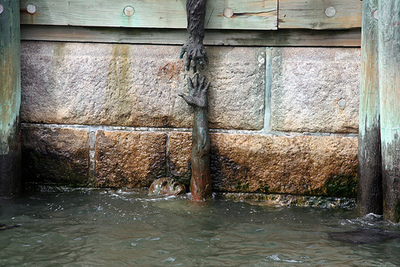
American Merchant Mariners’ Memorial
The awesome Scouting NY blog has more photos of the memorial: “two men are desperately crying for help while a third tries to pull a victim from the water. I can’t tell you how moving this is at high tide, when the water laps at the man.”

Too literal for my taste. The expression almost saves it.

obsessivecompulsive:

American Merchant Mariners’ Memorial

The awesome Scouting NY blog has more photos of the memorial: “two men are desperately crying for help while a third tries to pull a victim from the water. I can’t tell you how moving this is at high tide, when the water laps at the man.”

Too literal for my taste. The expression almost saves it.

iheartmyart:


AES + F, Half Life

true

iheartmyart:

AES + F, Half Life

true

iheartmyart:

Jimmie Durham, All That is Solid Melts into Air

iheartmyart:

Jimmie Durham, All That is Solid Melts into Air
travellinglight:


(via therifle)
Plot
A man (later identified as a thief) representing The Fool, a tarot card typically depicting a young man stepping off a cliff, lies face down on the ground, having fallen from the cliff. He is befriended by a footless, handless dwarf (representing the five of swords: defeat) and goes into a city to make money from tourists. The thief’s resemblance to Christ inspires some to use his likeness for the crucifixes which they sell. After a dispute with a priest who rejects the thief’s wax likeness of himself, the thief eats off the face of his wax statue and sends it skyward with balloons, symbolically eating the body of Christ and offering “himself” up to heaven. Soon after, he notices a crowd gathered around a large tower, where a large hook with a bag of gold has been sent down in exchange for food. The thief, wishing to find the source of the gold, ascends the tower; finding the alchemist (played by Jodorowsky).
After a confrontation with the alchemist, the thief defecates into a container. The excrement is transformed into gold by the alchemist who proclaims: “You are excrement. You can change yourself into gold.” The thief is introduced to seven people who are said to be the most powerful but who, like the thief, are mortal. They are related to the planets in astrological terms and portrayed with broad-brush satire, each personifying the worst aspects of his or her planet’s supposed characteristics. The seven consist of: a cosmetics manufacturer, a weapons manufacturer, a millionaire art dealer, a war toy maker, a political financial adviser, a police chief and an architect. They are gathered together by the alchemist who instructs them to burn their money and wax images of themselves.
After several scenes wherein the characters are led by the alchemist through several death/rebirth rituals, they all journey to Lotus Island to gain the secret of immortality from nine immortal masters who live on a holy mountain. Once on Lotus Island they are sidetracked by the “Pantheon Bar”, a cemetery party where people have abandoned their quest for the holy mountain and instead engage in drugs, poetry or acts of physical prowess. Leaving the bar behind, they ascend the mountain and each have personal symbolic visions representing each characters worst fears and obsessions. Near the top, the thief is sent back to his “people” along with a young prostitute and an ape who has followed him to the mountain. The rest confront the cloaked immortals who are shown to be only faceless dummies. The alchemist then reveals the film
 apparatus just outside the frame (cameras, microphone, lights and crew) and instructs everyone (including the audience for the film) to leave the holy mountain. “Real life awaits us,” he says. The screen fades to pure white.

(There is no way in hell that someone could read this plot and not want to watch the movie)
The Holy Mountain (1973)

Alejandro Jodorowsky (via Senses of Cinema)


Mmh, OK.
travellinglight:

(via therifle)

Plot

A man (later identified as a thief) representing The Fool, a tarot card typically depicting a young man stepping off a cliff, lies face down on the ground, having fallen from the cliff. He is befriended by a footless, handless dwarf (representing the five of swords: defeat) and goes into a city to make money from tourists. The thief’s resemblance to Christ inspires some to use his likeness for the crucifixes which they sell. After a dispute with a priest who rejects the thief’s wax likeness of himself, the thief eats off the face of his wax statue and sends it skyward with balloons, symbolically eating the body of Christ and offering “himself” up to heaven. Soon after, he notices a crowd gathered around a large tower, where a large hook with a bag of gold has been sent down in exchange for food. The thief, wishing to find the source of the gold, ascends the tower; finding the alchemist (played by Jodorowsky).

After a confrontation with the alchemist, the thief defecates into a container. The excrement is transformed into gold by the alchemist who proclaims: “You are excrement. You can change yourself into gold.” The thief is introduced to seven people who are said to be the most powerful but who, like the thief, are mortal. They are related to the planets in astrological terms and portrayed with broad-brush satire, each personifying the worst aspects of his or her planet’s supposed characteristics. The seven consist of: a cosmetics manufacturer, a weapons manufacturer, a millionaire art dealer, a war toy maker, a political financial adviser, a police chief and an architect. They are gathered together by the alchemist who instructs them to burn their money and wax images of themselves.

After several scenes wherein the characters are led by the alchemist through several death/rebirth rituals, they all journey to Lotus Island to gain the secret of immortality from nine immortal masters who live on a holy mountain. Once on Lotus Island they are sidetracked by the “Pantheon Bar”, a cemetery party where people have abandoned their quest for the holy mountain and instead engage in drugs, poetry or acts of physical prowess. Leaving the bar behind, they ascend the mountain and each have personal symbolic visions representing each characters worst fears and obsessions. Near the top, the thief is sent back to his “people” along with a young prostitute and an ape who has followed him to the mountain. The rest confront the cloaked immortals who are shown to be only faceless dummies. The alchemist then reveals the film

apparatus just outside the frame (cameras, microphone, lights and crew) and instructs everyone (including the audience for the film) to leave the holy mountain. “Real life awaits us,” he says. The screen fades to pure white.

(There is no way in hell that someone could read this plot and not want to watch the movie)

The Holy Mountain (1973)

Alejandro Jodorowsky (via Senses of Cinema)

Mmh, OK.

Via iheartmyart: Marta Minujin with Andy Warhol, Husking Corn
ohcarlos: Unknown.

Erwin Olaf
“ I am a photographer, and can’t help noticing how potent the search for significance is. The absurd task of imposing a rectangle on the flow of the world, and calling that rectangle important, seems to have no end and no zenith. Tim Davis, ‘One Credo After Another’, 2009 (via kirstenbecken)
“The first man to compare the cheeks of a young woman to a rose was obviously a poet; the first to repeat it was possibly an idiot.” — Dali 
via ameliorer

“The first man to compare the cheeks of a young woman to a rose was obviously a poet; the first to repeat it was possibly an idiot.”
— Dali

via ameliorer

iheartmyart:

Felipe Barbosa, Coke

Yo dawg…

iheartmyart:

Felipe Barbosa, Coke

Yo dawg…

Via catrionaclayson: kounellis 12 horses
 I once saw a large retrospective of kounellis in het Stedelijk in Amsterdam. Which was enough to put me off him immediately. But this is good; appeals to all the senses and a wide range of art history and influences, from classicism to arte povera; I like it.

Via catrionaclayson: kounellis 12 horses

I once saw a large retrospective of kounellis in het Stedelijk in Amsterdam. Which was enough to put me off him immediately. But this is good; appeals to all the senses and a wide range of art history and influences, from classicism to arte povera; I like it.

via whileyouwereout
O YES
Digging the surroundings as well.
Or is this a REUTERS image of a MOB crime?

via whileyouwereout

O YES

Digging the surroundings as well.

Or is this a REUTERS image of a MOB crime?

via iheartmyart: 


 Jonathan Schipper, The Slow Inevitable Death of American Muscle
….installation that slowly crashed two American muscle cars together into a crash. Stunning.

via iheartmyart:

Jonathan Schipper, The Slow Inevitable Death of American Muscle

….installation that slowly crashed two American muscle cars together into a crash. Stunning.